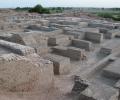
"South Asian studies" academics in the US would do well to introspect how they wittingly or unwittingly become part of Pakistan's proxy war in wielding influence over academics and policy, says Sankrant Sanu.

The rumblings of discontent from Righteous Europe over Qatar's admittedly appalling human rights record can only be viewed as deeply disingenuous and phoney, argues Kanika Datta.

"Throughout our history we've learned this lesson -- when dictators do not pay a price for their aggression, they cause more chaos. They keep moving. And, the costs and threats to America and the world keep rising," Biden said addressing the joint session of the Congress in his first State of the Union.

'It was always anticipated that the return of the Taliban would embolden armed Islamists including anti-India groups like the Lashkar and Jaish.'

The minister's visit will also give India an opportunity to have first-hand assessment of evolving security situation in that region.

An Indian connection to the war crimes tribunal has emerged, further complicating matters, says RS Chauhan

The Taliban have the ISIS in its crosshairs. The Taliban has shown the skill to assimilate extremist elements if they are reconcilable as well as the ruthlessness to eliminate troublemakers, observes Ambassador M K Bhadrakumar

Blinken will also attend a meeting of the foreign ministers of the Quad grouping and will hold bilateral talks with his Indian counterpart S Jaishankar in Delhi.

The dreaded Islamic State militia on Tuesday posted a video showing two Japanese captives, threatening to execute them if their nation's government failed to pay up a ransom of $200 million (over Rs 1,200 crore) within 72 hours.

'We could crack IM modules in the country because one arrested member would spill beans on the other.' 'With ISIS, every module is different and is possibly being handled by different operators abroad.'

'Manmohan Singh's fond hope of avoiding conflict over territory by 'making borders irrelevant' is increasingly difficult to realise in a world where institutional restraints on aggression are weakening and the new game in town is unalloyed power play,' notes T N Ninan.

While many Western countries, including the United States, Britain and Australia, are diplomatically boycotting the Winter Olympics over China's human rights record, Putin will join a number of Beijing-friendly leaders at the Games.

When a Chinese warship entered Japanese waters, the Indian commander called on China to maintain discipline at sea. Dr Rajaram Panda explains the significance of the Malabar exercises between India, Japan and the US.

The Biden administration should expect continuity in Iran's policies under Raisi. This may not necessarily mean that strengthening of ties with the West will be Raisi's top priority, observes Ambassador M K Bhadrakumar.

The residents of Delhi stand to lose 10 years of life expectancy if the current air pollution level persists.
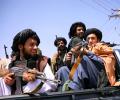
India is worried about Pakistan getting the Taliban to ignite trouble in Kashmir, observes Ramesh Menon.

'India enjoys the maneuverability of a coming big power.' 'It is this possibility that has persuaded Moscow to humour India and stayed Washington from getting punitive about India's neutrality on the Ukraine issue.'

India is apprehensive about the Taliban's return as it would mean loss of access to Baluch rebels and help to the restive tribals of Waziristan. This would be a setback to the Indian strategy of returning the compliments of death by a thousand cuts to Pakistan, notes Colonel Anil A Athale (retd).

The IAF chief also said Pakistan has become a pawn of Chinese policy and its dependence on China would increase further in future. He said India needs to understand the interplay of some major events in its vicinity that would impact the security scenario of the region.
'All they need is proper leadership.'
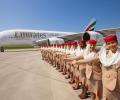
These special fares are a small gesture of appreciation from Emirates for its customers in India.

'That is important for Modi politically when he launches a do-or-die campaign seeking a renewed mandate in the 2019 poll,' says Ambassador M K Bhadrakumar.

'Putin is in danger of losing face in his Ukrainian adventure. His bluster is a response to this.'

'India was in no position to wage another war in 1965, having suffered a morale-shattering defeat in 1962. The three services were in the middle of a modernisation and expansion phase and therefore not fully trained or battle-ready.'

The US and its allies must evolve a more comprehensive long-term plan to defeat the new danger that the caliphate poses to the world order. And India too must do its bit for course correction, says strategic expert Gurmeet Kanwal.

'The big power struggle in faraway Europe erupted at a most critical juncture when India has been increasingly sceptical about American policies and statesmanship,' argues Ambassador M K Bhadrakumar.

'The RSS ideology has been borrowed from fascism and is not borne out of Hinduism.' 'They want India to have one historical identity whereas India is a land full of divergence which goes in every direction.'

'The hardliners in Delhi are in for a big disappointment,' predicts Ambassador M K Bhadrakumar.

'Washington appears to be playing the long game, and making the argument to India that over the longer term, Russia -- sanctioned, cash-strapped, isolated by the West -- will no longer be a viable defence partner for India'
.jpg)
The company will be increasing the prices of its compact car Beat, SAIL and multi-purpose vehicle Enjoy by 1.5 per cent, which translates to a range of Rs 2,000 to Rs 10,000.
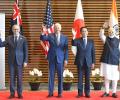
India has the ability in all respects to be a great power and address our security challenges in the best national interests, says Commodore Venugopal Menon (retd).
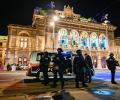
Europeans believe that what is under attack is their way of life, their secular faith, the long-fought right to keep religion out of the public sphere, observes Virendra Kapoor.

Notwithstanding how the current impasse is solved, at some point in the future, Russia will realise that just as centuries ago it developed the paradigm of securing its heartland's safety through annexing vast buffer zones between itself and the enemy, a more modern security is possible only through friendly relations and sustainable peace, observes Shyam G Menon.
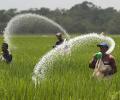
Enthused by rising potato prices after a prolonged slump, Pradeep Sharma was planning to sow the crop on his 15-acre farm near Agra slightly earlier than usual. The delayed departure of the southwest monsoon also prompted his decision, since the good soil moisture would have saved at least one initial irrigation. But the acute shortage of diammonium phosphate (DAP), a crucial nutrient ahead of the sowing season for potatoes, nipped those hopes in the bud. DAP is the second-most used fertiliser in the country after urea.

High frequency indicators suggest that a growth recovery is underway, but very tentatively and with weak legs, says Saugata Bhattacharya.

'The stage is set for increasing tensions in a highly volatile region as crucial as ever from a geopolitical standpoint,' predicts Claude Smadja.
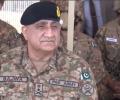
The chief of the army staff said that with one-third of the world in the Gulf region and elsewhere involved in some sort of conflict and war, "it is important that we keep the flames of fire away from our region."
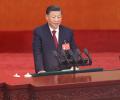
'Which will not happen.' 'Foreign Minister S Jaishankar has expressly refuted Beijing's statement that normalcy was returning to Sino-Indian relations.'
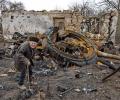
Any Indian government at this juncture would have voted and spoken exactly this way. It isn't just about the vast Indian dependence on Russian-origin military equipment. It is also about trust, asserts Shekhar Gupta.

An Afghan businessman is believed to be allegedly indoctrinating youth from Maharashtra to join the dreaded Islamic State.
 © 2026 Rediff.com - Advertise with us - Disclaimer - Privacy Policy - Sitemap - Feedback - About us - Terms of use - Grievances